
Dental implant or bridge: how do you choose?
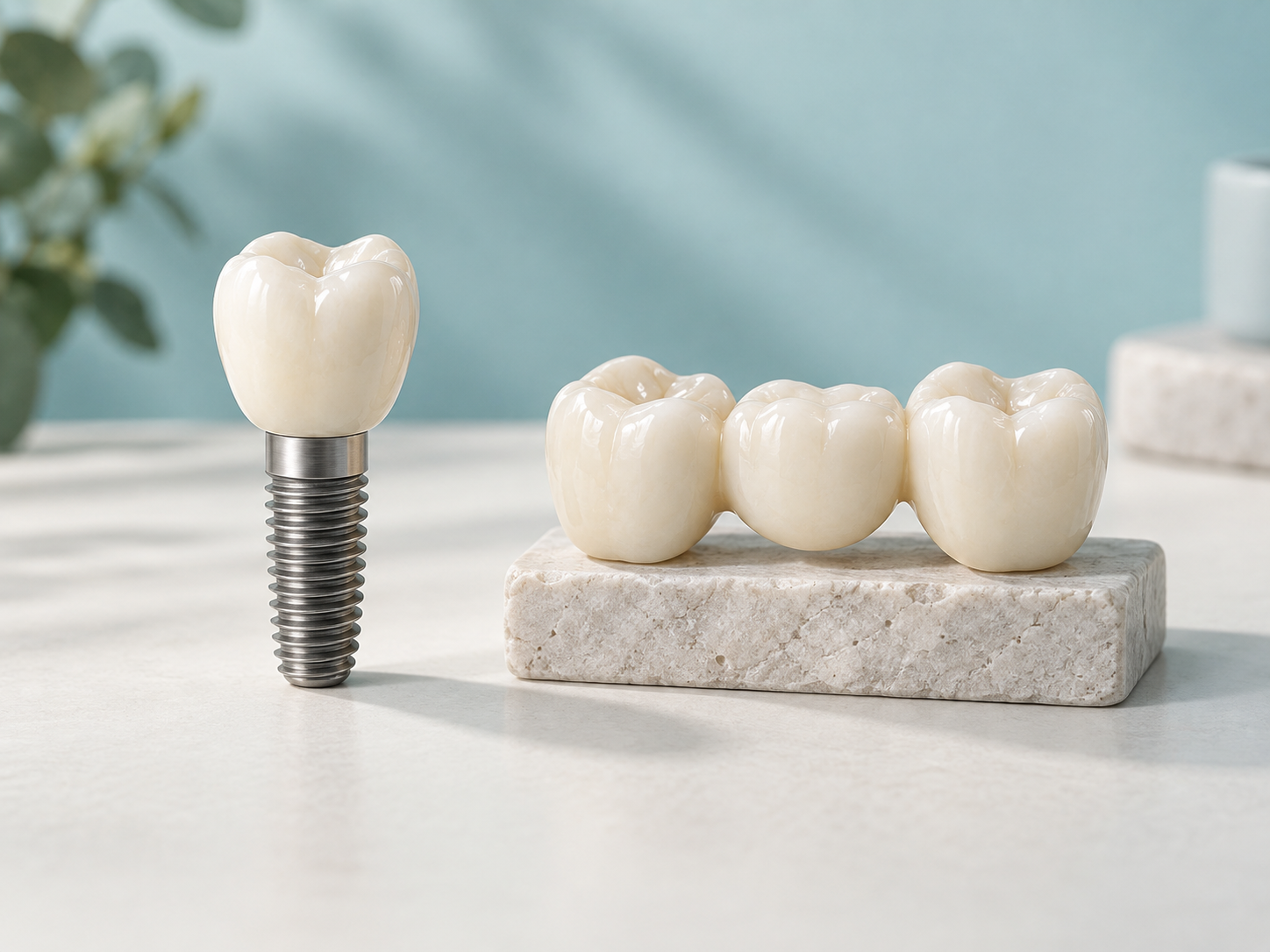
An implant and a bridge can both provide a fixed replacement for a missing tooth. The choice depends on the teeth beside the gap, the bone, your bite, your health and what treatment you are comfortable having.
One of the most useful questions is: what would each option involve for the healthy teeth and tissues you still have?
How are they different?
An implant crown is supported by a post placed surgically in the jawbone. A tooth-supported bridge uses one or more neighbouring teeth to hold the replacement tooth.
There are different types of bridge. A conventional bridge uses crowns on supporting teeth. A resin-bonded bridge, sometimes called an adhesive or Maryland bridge, attaches a supporting wing to a neighbouring tooth and can require little or no drilling in suitable cases. It is misleading to say every bridge requires two healthy teeth to be cut down. Leeds Dental Institute describes the two approaches.
What holds the replacement tooth?
Implant crown: An implant in the jawbone
Conventional bridge: A crowned supporting tooth or teeth
Resin-bonded bridge: A wing bonded to a supporting tooth
Does it involve implant surgery?
Implant crown: Yes
Conventional bridge: No
Resin-bonded bridge: No
What happens to neighbouring teeth?
Implant crown: They do not support the implant crown
Conventional bridge: They are prepared for supporting crowns
Resin-bonded bridge: Little or no preparation may be possible
What needs particular assessment?
Implant crown: Bone, gums, health and implant position
Conventional bridge: Strength and condition of supporting teeth
Resin-bonded bridge: Available bonding surface, gap and bite
What needs maintenance?
Implant crown: Crown, connection and tissues around the implant
Conventional bridge: Bridge and supporting teeth
Resin-bonded bridge: Bridge, bond and supporting tooth
When might an implant make sense?
An implant can be attractive when the teeth beside the gap are healthy and there is a suitable site for placement. It gives the replacement tooth its own support.
That benefit needs to be weighed against surgery, healing time, cost and ongoing care. If the site needs substantial grafting, the balance may change. An implant is not automatically the simplest option because it leaves neighbouring teeth unprepared.
If your tooth was removed some time ago, see getting an implant years after tooth loss.
When might a bridge make sense?
A conventional bridge may deserve consideration when an adjacent tooth already needs a crown. Its suitability still depends on whether that tooth is strong enough to support the proposed bridge.
A resin-bonded bridge may offer a more conservative option in a suitable gap. It can come unstuck and may need rebonding or a different solution. It is not suitable for every bite or every missing tooth.
Ask your dentist to show you which teeth would support the bridge and explain what would happen if a supporting tooth later developed a problem. That makes the comparison more meaningful than treating “a bridge” as a single, uniform treatment.
Which is quicker?
An implant generally involves a period of bone healing before the final crown. At Ethical Dental, a single implant typically takes 4–6 visits over 4–8 months, with timing adjusted to the treatment required.
A bridge can avoid that implant-healing stage. The overall time still depends on whether an extraction, healing, gum treatment or other dental work is needed first. Ask what you would wear in the gap during treatment, as well as when the final tooth could be fitted.
Which lasts longer?
Neither option comes with a lifetime guarantee. An implant can remain in place while its crown needs repair; a bridge may remain in service but need treatment to a supporting tooth. Comparing those outcomes as if they were identical can be misleading.
Discuss the likely repair needs for your own plan, the cost of maintaining it and how it can be cleaned. For bridges, cleaning underneath the replacement tooth is particularly important. Implant treatment also requires ongoing checks and cleaning around the implant.
How do the costs compare in Coffs Harbour?
At Ethical Dental, a standard three-unit bridge and a single back-tooth implant both cost around $4,500. The fees are kept similar so the decision can focus on which treatment suits your mouth, the effect on neighbouring teeth and your preferences.
A three-unit bridge replaces one missing tooth with two supporting crowns and one replacement tooth, called a pontic. Our published crown fee is $1,943 per crown. With a usual pontic fee of $650, those components total $4,536. Your written plan confirms the fee for your bridge.
The $4,500 back-tooth implant fee includes placement, a custom abutment, a ceramic crown and review visits. The $95 tooth-replacement consultation includes the 3D scan and is separate from treatment. Front-tooth implants and longer bridges are quoted individually.
A resin-bonded (Maryland) bridge costs $2,304. Your written treatment plan confirms suitability and any additional treatment required.
Additional treatment, such as extraction, treatment of supporting teeth, grafting or a temporary tooth, is itemised when needed. The total for either option can therefore differ from the restoration fee.
Compare complete written plans for the same problem. A price for an implant post alone is not directly comparable with a price for a finished tooth.
What if neither option suits me?
A removable partial denture or leaving the space under review can also be discussed. The importance of replacing the tooth depends on the gap, your bite and your concerns; it should not be assumed from a photograph alone.
Dr Sam Rosehill assesses tooth-replacement options at our Coffs Harbour clinic. See our implant treatment and fees, or request a consultation to compare the choices for your missing tooth.
Fees checked September 2026. Your written plan confirms the treatment and fees that apply to you.